 Wildwood Mobile Home Leveling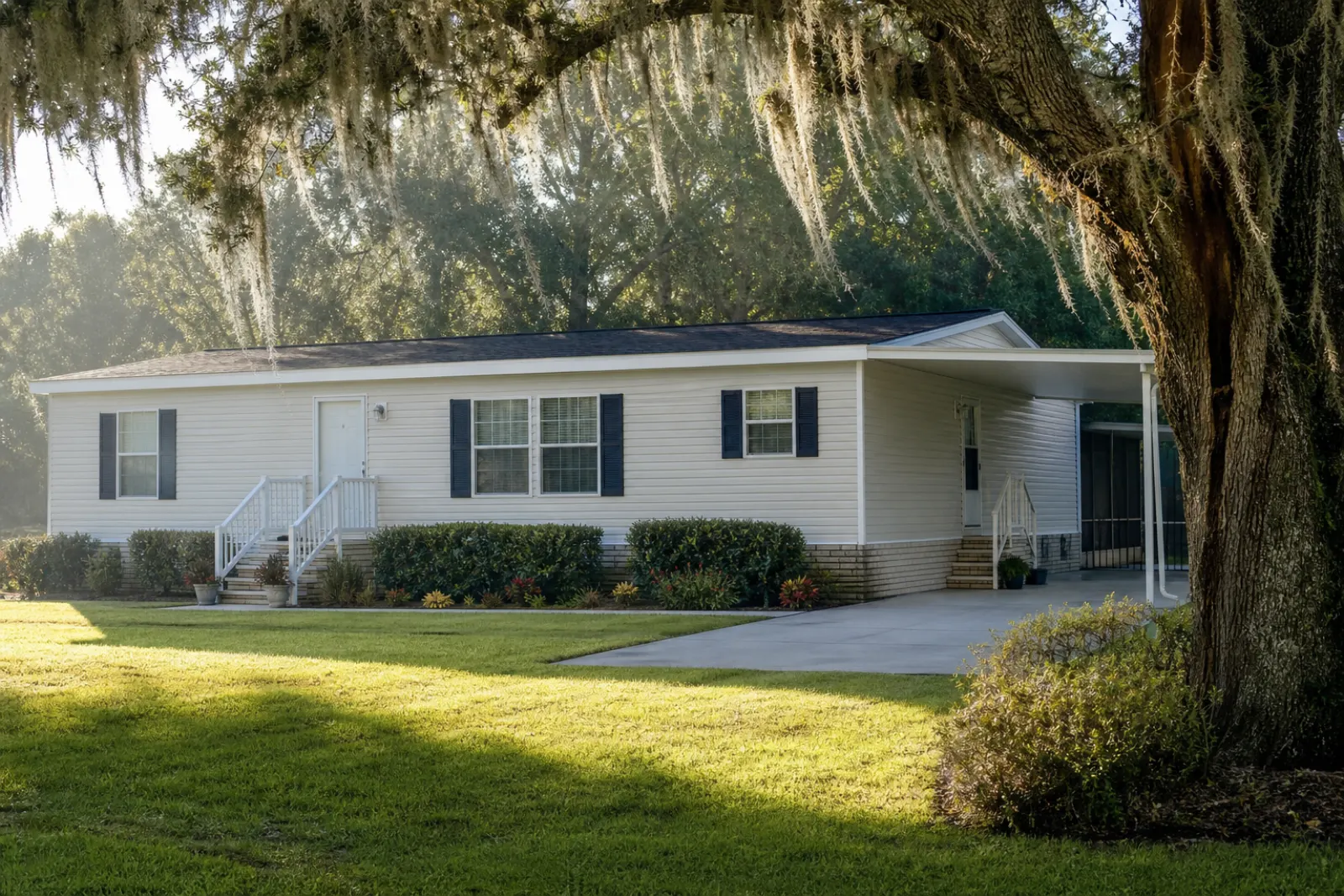
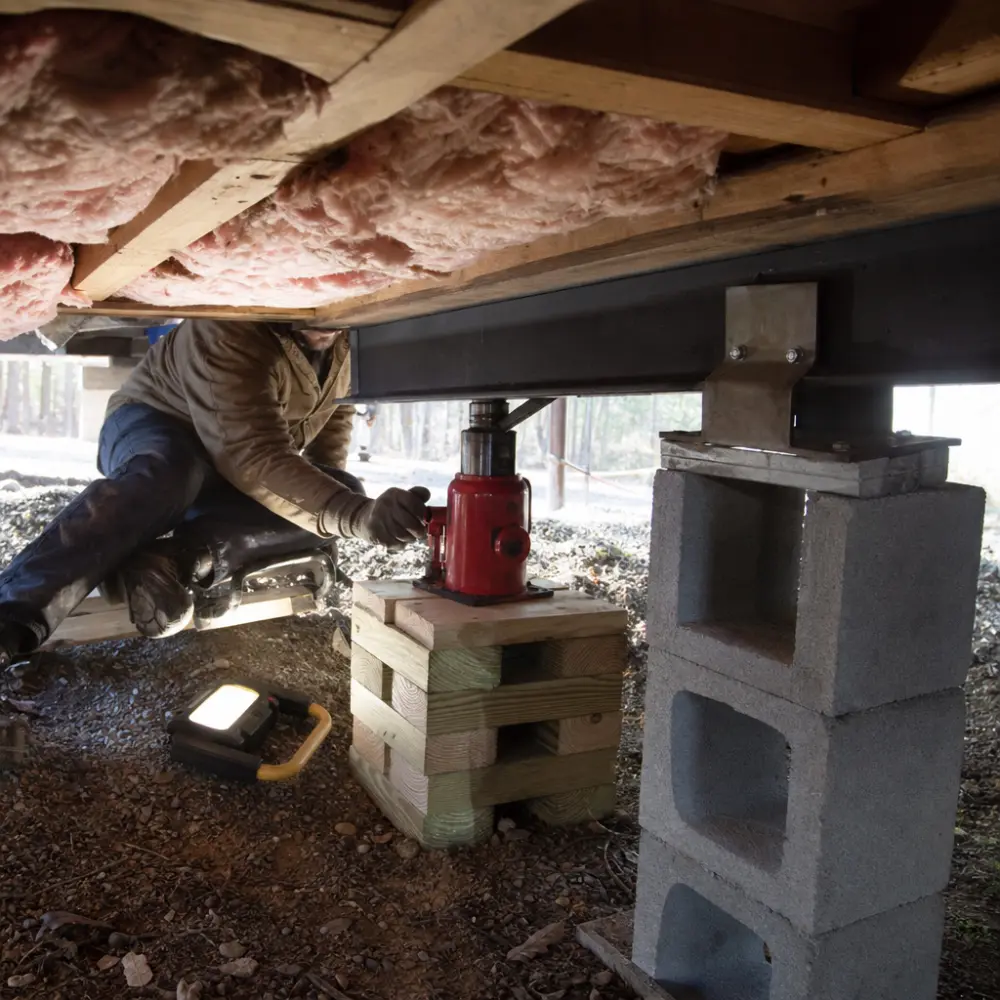
Wildwood Mobile Home Leveling puts settled manufactured homes back on the level line across Wildwood, Sumter County, and the towns around The Villages. Every pier gets shot with a water level, the frame comes up on hydraulic jacks carried by solid cribbing, and each low pier is rebuilt with fresh hardwood shims until the whole chassis reads flat again. A singlewide relevel is $450 to $800 and a doublewide $750 to $1,400. The survey that tells you exactly what your home needs costs nothing.
Sticking doors, a hallway with a lean in it, a ceiling seam that has opened on a doublewide: those are the reasons people call, and around here they trace back to the same two things, the sand and the rain.
The crossroads is growing, and the older homes are still here
Wildwood calls itself the Crossroads of Florida, and the name is earned: Interstate 75, the northern end of Florida’s Turnpike, State Road 44, and US 301 all meet inside the city. The Turnpike runs about 265 miles up from Miami and simply ends at I-75 here, and the state finished a $68.5 million rebuild of that interchange in January 2020 with new flyovers tying I-75 and the Turnpike into SR 44. The city grew from 15,730 people at the 2020 census to an estimated 19,436 by 2025, and it has annexed 21,644 acres since 2005 to reach 26,853 acres, most of it for The Villages, whose final town center at Brownwood sits inside Wildwood’s city limits. Sumter County had the oldest median age of any county in the country in the 2022 estimates, 68.1 years, and Wildwood’s own median age is 62.5, with 43.5 percent of residents 65 or older.
That growth is site-built homes. The manufactured homes were mostly here first. The Florida Department of Health’s housing indicator, drawn from the Census Bureau’s American Community Survey, puts mobile homes at 11.3 percent of Sumter County’s housing units in 2024, against 8.0 percent statewide, and at 16.3 percent in Lake County next door. Around Wildwood that means the 55+ lots at Continental Country Club on SR 44 East, where residents own their lot and a share of the club, the roughly 150 manufactured homes at Wildwood Country Resort south of SR 44 along Buena Vista Boulevard, the age-restricted Parkwood Communities on Springlake Road, and the older parks along State Road 44 and the county roads: Rail’s End, Eaglewood, Wildwood Acres, Lakeside Mobile Court on CR 150, Moreland Park on CR 230. Nearly all of it stands on block piers.
The ground under Wildwood
Sumter County is what geotechnical engineers call covered karst: a blanket of sand and clayey sand over the Ocala Limestone, which sits close to the surface across much of the county. The Southwest Florida Water Management District describes the ground around Lake Okahumpka, the 600-plus-acre lake on the south side of SR 44 east of town, as an erosional valley in a limestone terrain with thin surficial sands. Lake Deaton sits across the road on the north side of SR 44. When you crawl under a home here you are on a few feet of sand with rock not far below it, and in places the sand is working its way into the rock: that raveling of fines into limestone voids is the sinkhole mechanism, and while reported sinkhole activity in Sumter is lower than in the Citrus, Hernando, and Pasco belt to the west, the mechanism is present.
The sand itself is the everyday problem. The NRCS soil survey for Sumter County maps the uplands around Wildwood and Oxford in Candler sand, which it calls excessively drained with no zone of saturation within 72 inches, and in Arredondo and Kendrick fine sands, both well drained on the ridges. Tavares fine sand on the lower knolls is moderately well drained with a seasonal water table at about 57 inches from June through December. Then there are the flats and rises the survey labels with a bouldery subsurface, Adamsville, Sparr, and the Sumterville-Mabel-Tavares association, where the water table comes up to 23 to 33 inches through the summer and where limestone boulders sit in the profile. Sumterville and Mabel carry clay and a moderate shrink-swell rating, which is rare in Florida and which moves a pier pad in a different way than sand does.
Loose, single-grain sand rearranges itself under a point load every time water moves through it. A manufactured home puts a few thousand pounds on each pier through a footing about the size of a doormat. The NOAA 1991 to 2020 climate normals for the Lisbon station, on the Lake County side toward Leesburg, put annual rainfall at 50.03 inches with 27.79 inches, 55 percent, in June through September; Ocala’s station reads 51.64 and 27.91. Every afternoon storm from June to September pushes water through the sand under the piers, and the side of the home under a roof valley or a downspout drops faster than the side in the sun. That difference is what racks the frame, and the frame is what your doors, windows, and floors hang off of.
The upshot is a maintenance interval rather than a repair. Homes on this ground generally need releveling every three to five years. That is not a sales line. It is why this business exists.
What settling looks like from inside the house
You rarely notice it from the yard. You notice it living in it.
- Doors rub, then drag, then stop latching. The opening is no longer a rectangle.
- Windows bind in their tracks, and sometimes crack at a corner.
- Floors slope or bounce. Put a marble down. If it travels, you are not imagining it.
- Cracks open at wall and ceiling joints, usually above doorways where the racking concentrates.
- A doublewide’s marriage line opens. The seam down the center separates at the ceiling or floor because the two halves are no longer at matched height.
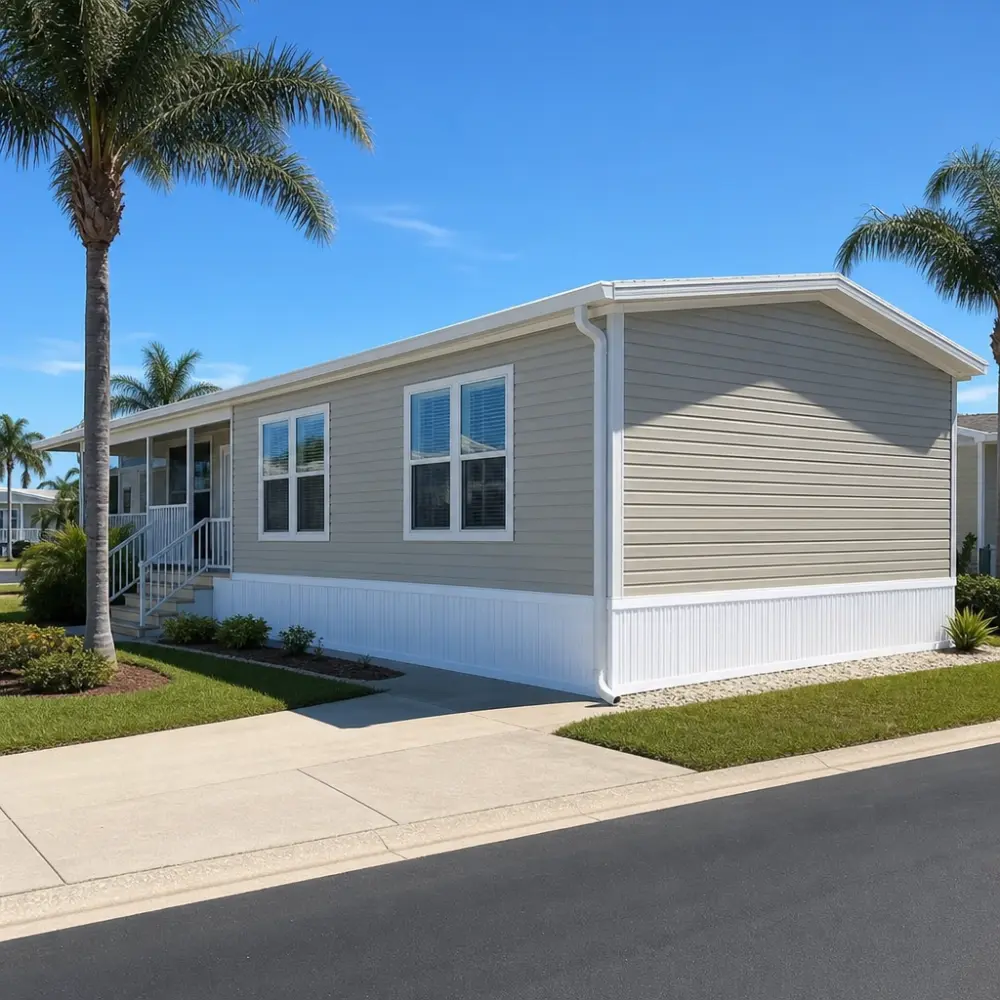
- Skirting bows or pulls away as the home descends onto panels that were never meant to carry weight.
Any one of those earns a free level check. Settling compounds: a pier that is an inch low today is grinding its own cap and shims, and it will be lower after next summer. Caught early it is a straightforward relevel. Left a few more seasons it becomes pier rebuilds, and the difference on the invoice is measured in hundreds of dollars. The problems pages take each symptom one at a time.
What a relevel involves
The survey. Access panels off, crew under the home end to end, every pier shot with a water level off a datum pier. You get a number per pier rather than an opinion. Pads, caps, and shims get handled, the belly gets checked, and every anchor strap gets looked at for tension and rust. The written price comes out of this, before anything is lifted.
The lift. Twenty-ton bottle jacks on solid wood cribbing at the frame near each low pier, working in small increments across several stations so the chassis comes back toward plane as a unit. The rule that separates competent work from dangerous work is simple: the cribbing carries the load, never the jack.
The pier work. Blocks re-stacked or replaced with the hollow cells vertical and each course turned at right angles to the one below, the way the federal installation standard at 24 CFR 3285.304 requires. Crushed caps and pads swapped out. Hardwood shims driven tight in pairs. That same standard caps shims at one inch of vertical height and hardwood plates at two inches nominal, so a pier that cannot reach the beam inside that allowance gets rebuilt at the right height instead of stacked taller. That is priced separately and openly.
The verification. The frame is re-shot end to end. Every pier has to be carrying load, which you confirm by hand, because a home can read level while standing on piers that are doing nothing. On a doublewide both halves have to read matched at the center row.
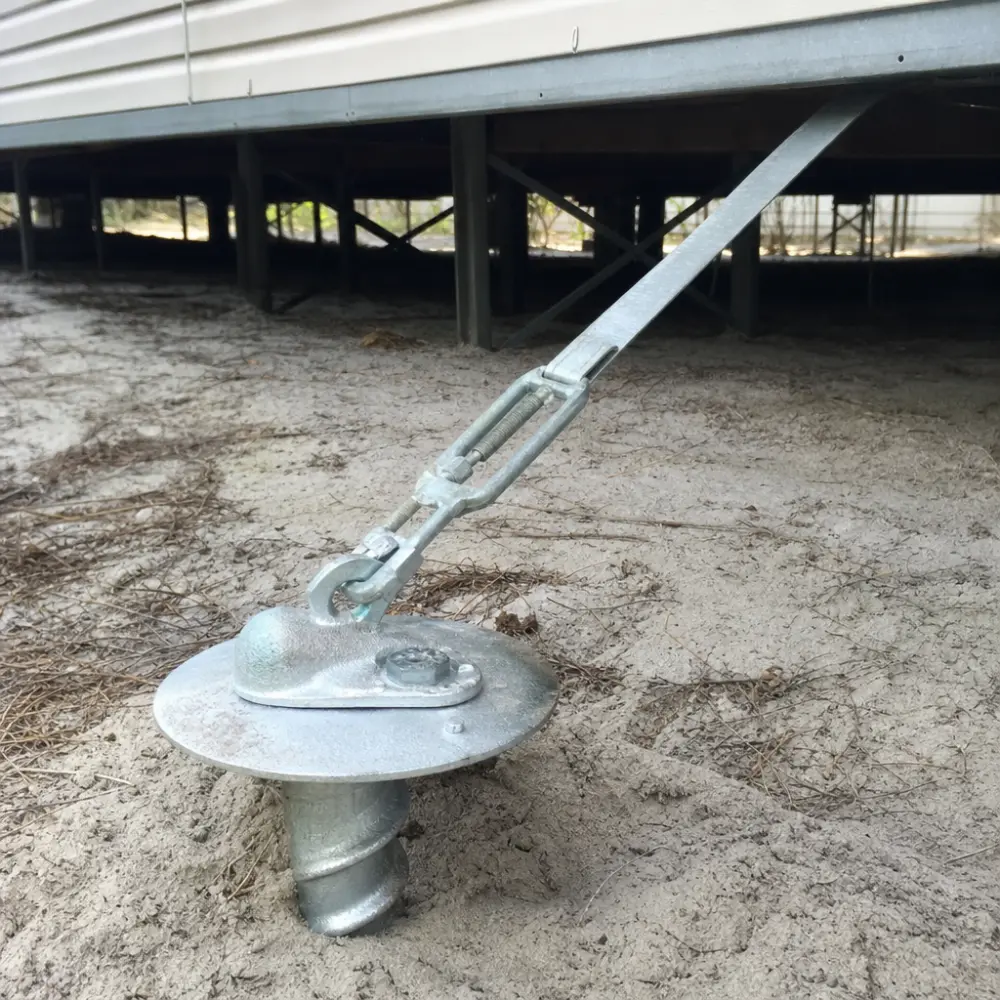
The straps. Anchor straps get re-tensioned, because raising the home changes the tension they were set at. If the anchor system is short, corroded, or built to the pre-1994 standard, you get told and it gets quoted separately rather than quietly added.
Everything we do
- Mobile home leveling. The core service. Survey, lift, shims, whole-frame verification, most homes in a day.
- Pier and pad repair. Reset, reshim, or fully rebuild settled piers and the footings under them. $75 to $150 a pier to reset, $150 to $400 to rebuild.
- Tie-downs and anchors. Install, replace, and re-tension ground anchors and straps to Florida Rule 15C-1 in HUD Wind Zone II, which is where 24 CFR 3280.305 places Sumter and Lake counties.
- Vapor barrier replacement. Repair or replace the sealed underbelly that keeps ground moisture out of your insulation and subfloor.
- Skirting repair. Panels, vents, and access doors, including the storm damage that arrives most summers.
- Pre-sale leveling inspection. A written level, support, and anchoring report for parks, lenders, insurers, and buyers. $150 to $350, credited toward any work it finds.
- Mobile home transport and setup. Full pull-and-set with the Sumter County permit package handled, itemized from a site visit.
The rates, published
Almost nobody in this trade will give you a number before they are standing in your yard. Ours have been on the website since it went up.
| Service | Typical range |
|---|---|
| Relevel, singlewide | $450 to $800 |
| Relevel, doublewide | $750 to $1,400 |
| Pier reset or reshim | $75 to $150 per pier |
| Pier rebuild | $150 to $400 per pier |
| Anchors and tie-downs | $600 to $3,500 |
| Vapor barrier | $300 to $800 patch, $1,200 to $4,500 full |
| Skirting | $200 to $800 repair, $900 to $2,500 full |
| Pre-sale inspection | $150 to $350 |
| Transport and setup | Itemized from a site visit |
Every leveling job starts with the free survey and ends with a firm written number. Against what deferral costs, leveling stays the affordable end of structural work: a few hundred dollars on a normal cycle instead of the pier rebuilds, rotted subfloor, and racked door frames that pile up when settling runs unwatched for a decade. The pricing page covers what pushes a job inside its range, and the cost calculator puts a range on your home now.
Wind Zone II, a tornado, two hurricanes, and the 1994 line
For a site-built house, wind resistance is built into the structure. For a manufactured home it is almost entirely the anchoring system, and that system degrades without announcing itself.
Wildwood’s worst wind on record did not come from a hurricane. At 3:08 in the morning on February 2, 2007, a tornado touched down near Wildwood in Sumter County, crossed into Lake County, and lifted east of Lady Lake at 3:25. The National Weather Service survey rated it EF-3 with winds of 155 to 160 mph over a 16.5-mile track. It went through the south side of The Villages and then through the mobile home communities off Griffin View Drive in Lady Lake, where eight people died, and the count afterward ran to more than 1,200 homes and mobile homes damaged and roughly 300 destroyed. Ten years later, on the night of September 10, 2017, Hurricane Irma tracked up the peninsula and put a 60-knot gust on Leesburg International Airport with 8.57 inches of rain on the Wildwood gauge, 9.18 and 10.59 inches on the two Villages gauges, and 11.03 at Lady Lake. Milton, on October 9, 2024, was gentler here: the Weather Service put Sumter County’s peak gusts at 40 to 50 mph, with 5 to 10 inches of rain, 11.71 near Lady Lake, and the Withlacoochee River in flood for weeks afterward.
None of that is why the anchors matter most. The 1994 line is. Florida Rule 15C-1.0104 specifies two anchor classes: Type I, tested to a 3,150-pound working load, for homes manufactured before July 13, 1994, and Type II, tested to 4,000 pounds, for homes built after. That date is when HUD’s post-Andrew wind standard took effect, and a large share of the park stock along SR 44 and in the older Lady Lake and Leesburg communities predates it. Straps go slack every time the home settles, which on this ground is continuously, and anchor shafts corrode below grade where nobody looks. That is why tie-down work and leveling are one conversation here rather than two, and why straps are re-tensioned as part of every relevel.
Who is allowed to do this work
Florida is specific about it. Section 320.8249 of the Florida Statutes puts mobile home installer licensing under the Department of Highway Safety and Motor Vehicles, and the department’s own FAQ says it plainly: “Section 320.8249, Florida Statutes and Rule 15C-2, F.A.C. require that only licensed mobile home installers set up a home in Florida.” Asked whether a homeowner can do it, the department’s answer is “No.” Setup, under section 320.822, is “the operations performed at the occupancy site which render a mobile home or park trailer fit for habitation,” which is what blocking, leveling, and anchoring are. Installing without a license is a first-degree misdemeanor.
A licensee completes a department-approved training course, passes an exam, posts a performance bond, carries liability insurance, and renews every year. Sumter County adds its own layer: Building Services, at the Villages Sumter County Service Center on Powell Road in Wildwood, issues mobile home permits only to a licensed installer, wants the foundation and blocking diagram with the manufacturer’s tie-down schematic, and requires a pre-permit inspection on any home fifteen years or older before it can be set. The installer licensing page walks through how to check a license in one call.
We bring this up unprompted because it protects you. Every crew arranged through us is a licensed, insured Florida mobile home installer. Ask every bidder for the same and pay attention to who gets quiet.
Where we work
Crews run out of Wildwood along SR 44, US 301, and CR 466. Oxford is up US 301 between the city and the Marion County line, with The Villages on its east side. Coleman is a few minutes southwest on US 301. Bushnell, the county seat, and Webster, home of the Monday flea market, are down US 301 and I-75 to the south. Across the county line, Lady Lake is where The Villages started as a mobile home park, and Leesburg between Lake Harris and Lake Griffin has some of the largest 55+ manufactured home communities in Lake County.
Book the free level check
Tell us what you are noticing, a door that will not close, a hallway with a lean, a seam that has opened, along with the home’s size and where it sits. A crew comes out, shoots every pier, and writes the price at the home while the readings are fresh. You get a pier-by-pier map, a firm number, and a straight answer about what needs doing now versus what can honestly wait. Questions first? The FAQ covers most of them, or read how we work.